Skip to content
Demo Polly
Contact Us

A Light at the End of the Tunnel

The last two years have been challenging for the property and casualty (P&C) insurance sector, especially within automotive retail.

2022 ushered in the hard market of 2023, which turned into one of the toughest years for the auto insurance industry in decades. Driven by rising loss costs due to inflation, supply chain issues, and natural catastrophes, P&C providers suffered increased underwriting losses, which they offset by raising premiums.

Consumers had fewer insurance options as carriers closed their doors to new or higher risk business. They also may have experienced higher insurance premiums as carriers adjusted prices to cover increased risks and losses.

Dealers weren’t able to, or were less inclined, to embrace insurance programs in the dealership. That’s all set to change this year. Polly data indicates that there is a light at the end of the tunnel and the auto insurance opportunity will pick up in 2024.

Embedded Auto Insurance Market Set to Improve in 2024

Market health bottomed out at the end of 2023. The embedded auto insurance market looks to improve dramatically in 2024.

States with challenged insurance markets due to regulatory constraints, high cost to insure, or high catastrophe risks are likely to open their insurance markets in 2024.

Carriers that had been reluctant to take on new business are rapidly beginning to onboard new customers now that profitability has stabilized. Premiums will likely begin to stabilize in 2024 as state-by-state increases that carriers requested in 2023 take effect. Dealers considering embedded insurance programs should act now to get ready for market opportunities in Q2 and beyond.
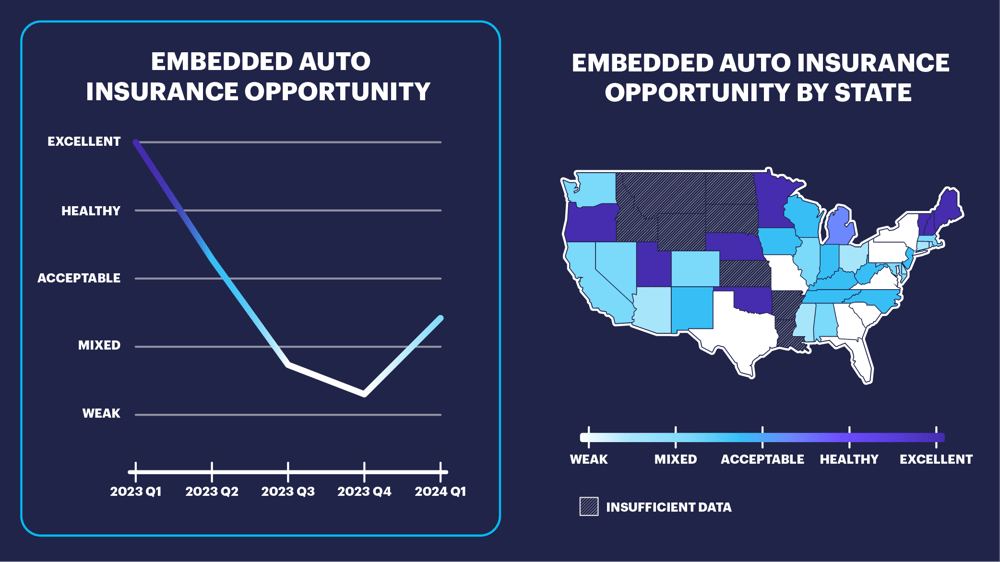
Embedded auto insurance opportunity falling from excellent in Q1 2023 to weak in Q4 2023, then rising to mixed in Q1 2024, with a map of opportunity by state

As Front-End Gross Continues to Decline from All-Time Highs, Back-End Gross Begins to Dip

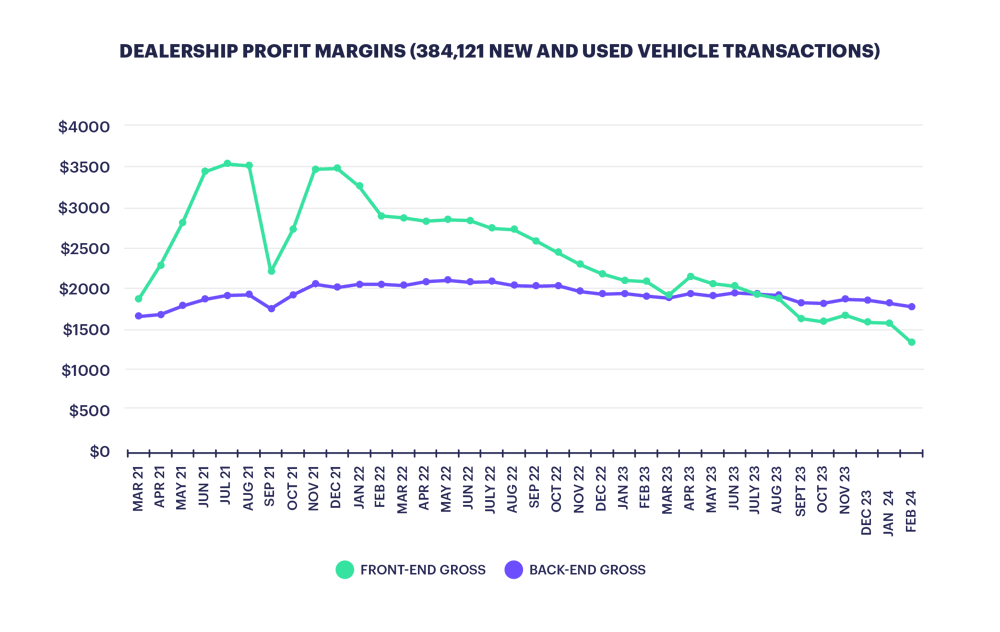
Line chart: dealership profit margins across 384,121 new and used vehicle transactions, with front-end gross falling from about $3,500 in 2021 to about $1,350 in February 2024 and back-end gross dipping below $1,800

While it’s no surprise that post-pandemic front-end gross is still high by historical measures, it has begun to decline from its all-time high (around $3,500 per sale) in the second half of 2021.*

What’s slightly surprising is that, until recently, back-end gross has stayed relatively flat over the three-year period ending in Feb. ’24. This indicates that back-end profits are less volatile and not as subject to macro-economic trends. However, back-end gross began to dip as interest rates continued to rise over 2022 and into 2023. The recent decline in back-end gross began late last year and continues into 2024.

19 Dealer Groups See Increased Back-End Gross with Customers Who Receive Insurance Quotes

The following graph represents back-end gross data from 19 dealerships representing 178 rooftops with statistically viable data on car sales and insurance volume (384,121 transactions). In every case, when insurance was introduced to customers at the dealership, dealerships saw an improvement in back-end gross.
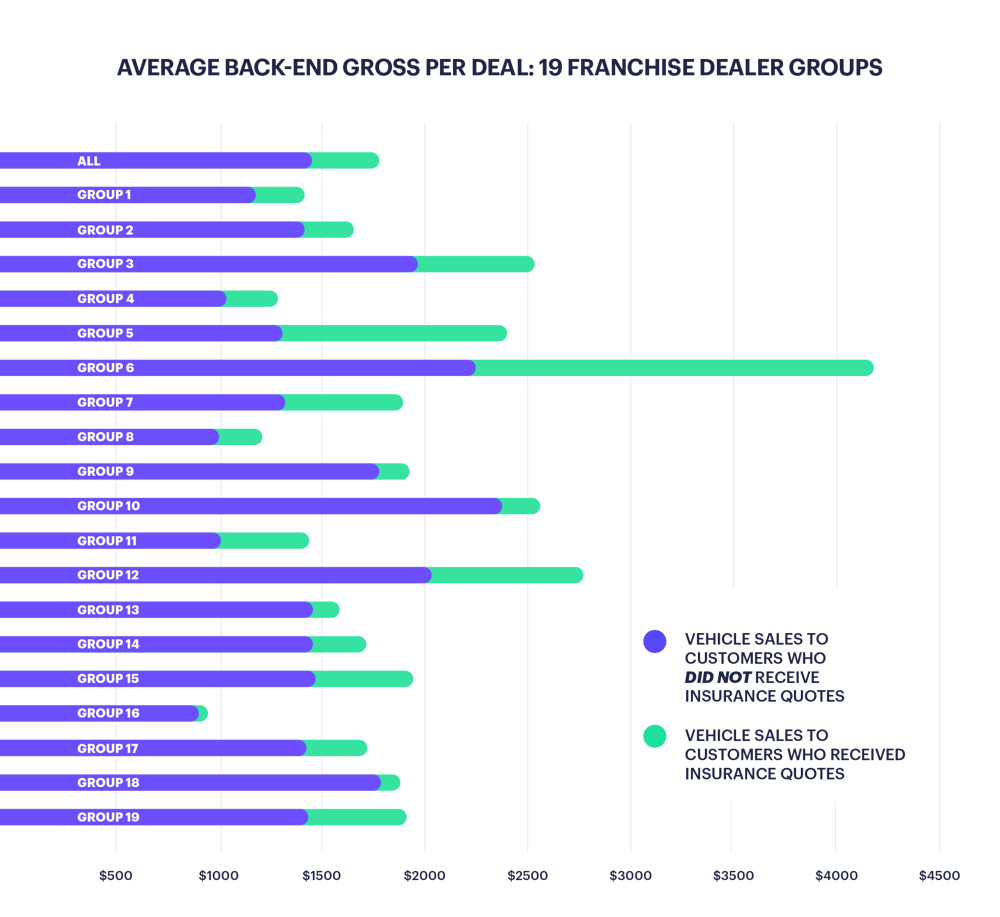
Bar chart: average back-end gross per deal for 19 franchise dealer groups, higher in every group for customers who received insurance quotes

Across 384,121 Vehicle Transactions, Customers Who Received Insurance Quotes Spent More in the F&I Office

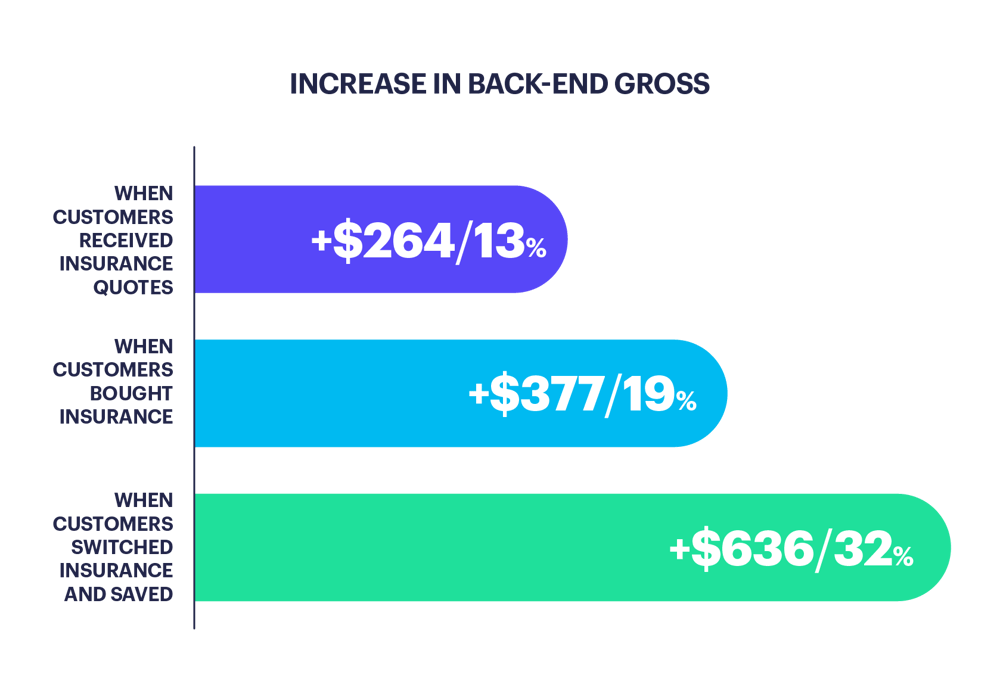
Increase in back-end gross: +$264 or 13% when customers received insurance quotes, +$377 or 19% when they bought insurance, +$636 or 32% when they switched insurance and saved

View the data behind this chart
Increase in back-end gross by customer action, Q1 2024
Customer actionDollar increasePercent increase
Received insurance quotes+$264+13%
Bought insurance+$377+19%
Switched insurance and saved+$636+32%

From Polly’s Q1 2024 Quarterly Embedded Auto Insurance Report.

Back-end gross improves (10% or more on average) as consumers move further down the insurance consideration funnel.

What’s important to highlight is that back-end gross lifted even if the car buyer didn’t buy insurance. Just having an insurance conversation and getting a customer competitive quotes was enough to correlate with back-end gross lift.

The improvement in back-end gross was visible even when there are no reported insurance savings but is biggest for car-buyers who reported savings of $10 or more per month. The 2023 average for Polly customers who save on insurance is $75 per month.*

Predictions for Q2 2024

The insurance market is improving in 2024.

With states opening up and the insurance market stabilizing, dealership customers will likely have access to a broader range of competitive insurance products from significantly more carriers. That means more opportunities for car buyers to save money on their insurance, which translates into higher profit margins for dealers.

Start Growing with Polly

Let embedded auto insurance be your dealership's next growth tool.

Get Embedded